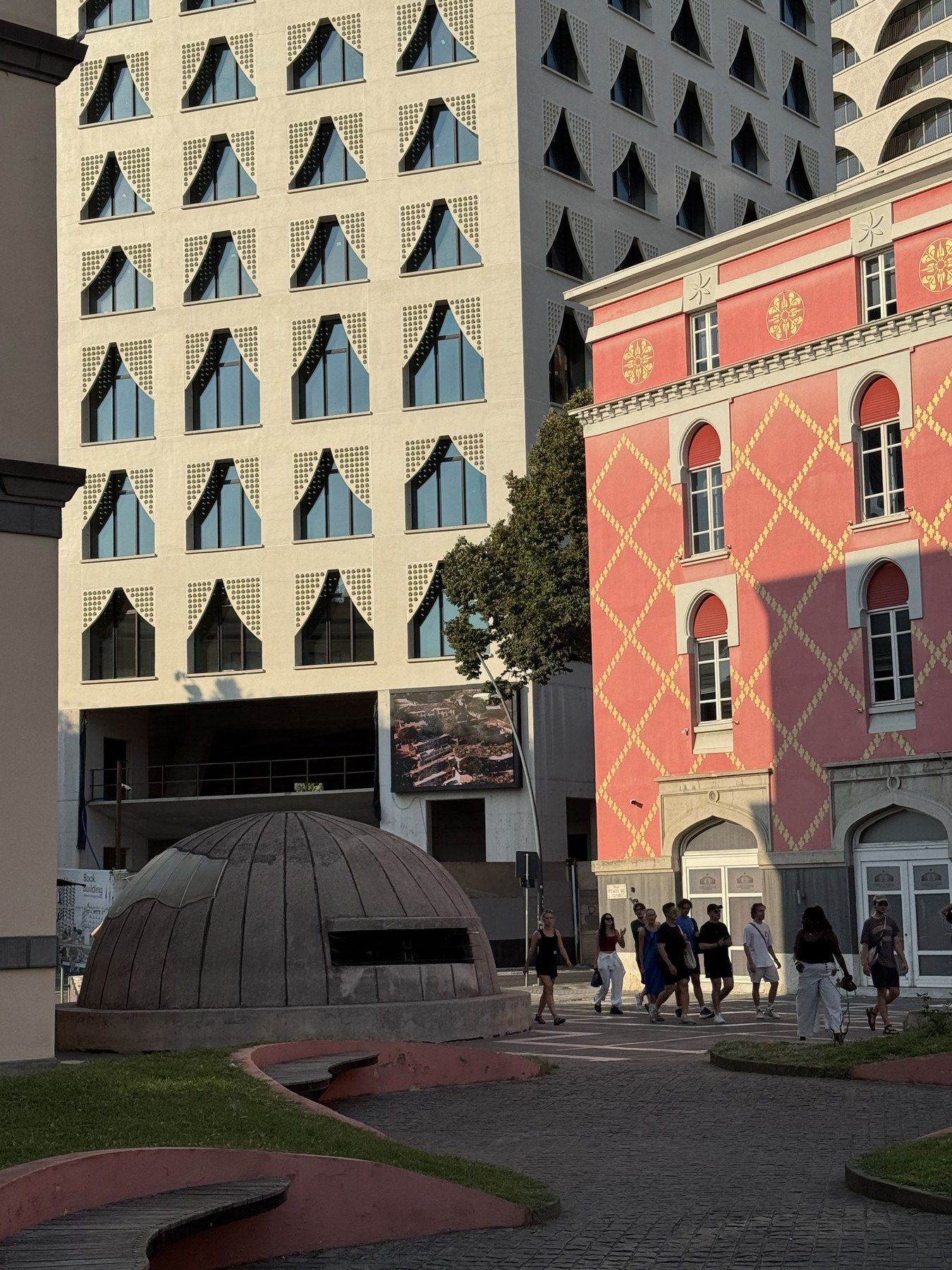
Tirana is, without a doubt, one of the most surprising cities we've visited. Albania's capital is emerging from one of 20th century Europe's most extreme communist regimes: 50 years under Enver Hoxha's dictatorship, a government that abolished private property, destroyed churches, covered the country with 170,000 bunkers, and spied on its own citizens. What surprises you most is that today, Tirana is a modern, vibrant, safe city eager to tell the world what it lived through.
We arrived in Tirana without knowing what to expect. We knew Albania was becoming known for its beaches and growing tourist appeal. What we didn't expect was that a single afternoon in the city would leave us so profoundly affected.
Albania and Communism: 50 Years Under Enver Hoxha
To understand Tirana, you first need to understand what Albanian communism was. And it was among the most extreme in the world.
Albania passed through various empires and gained independence in 1912. After World War II, following the defeat of the Germans who had occupied the country, Enver Hoxha rose to power as prime minister in 1946 and held it until his death in 1985. His successor maintained the regime until it finally fell in 1991, when a student movement toppled Hoxha's statue in the central square.
What does it mean to live under that system? Imagine having everything taken from you: your home, your car, your business. Private property simply ceases to exist. To eat, you can only buy bread and milk, rationed, and often when you arrive at the store there's nothing. You can't complain to your neighbor because you're being listened to. If someone in your family says something against the government, you go to prison. That was Albania for 50 years.
And that ended just 30 years ago. Many people walking through Tirana today lived through it themselves.
The House of Leaves: Albania's Spy Headquarters
Walking through central Tirana, there's a house covered in ivy that, if you don't know its history, you'll walk right past. It's called The House of Leaves, built in 1931. During the German occupation, the Gestapo used it. But its darkest chapter came under communism: Hoxha turned it into one of the Sigurimi's main centers, Albania's secret police.
From here, phone wiretaps, recordings, mail control, and surveillance of citizens deemed suspicious by the regime were all coordinated. When you enter, you begin to understand the extent of that control: hidden microphones, recording devices, cameras, photographic archives. Technology that seems rudimentary today but served to invade the private lives of thousands of families.
A conversation with a foreigner, a political opinion, a relationship with someone from outside. Anything could become grounds for denunciation. And the most disturbing part: the person who turned you in could be someone very close to you. Regime propaganda said the enemy could be anywhere, even inside your own family.
What strikes you most about this museum is that it's not a recreation. It's exactly as it was. When you go down to the basement, all of that history feels even heavier.
Blloku District: Hoxha's Private Neighborhood
Blloku is now one of Tirana's most modern and lively neighborhoods: cafes, restaurants, nightlife. But during communism, it was a completely closed district where Hoxha and his inner circle lived.
Ordinary people couldn't enter. Hoxha sent the message that he lived just like everyone else: in a small house, on a simple bed. The reality was very different. When the regime fell, a French artist bought the house, and it was only one or two years ago that it opened for locals to visit, once a month. Many people living in the neighborhood today don't even know which house it is.
Blloku is one of those contrasts you can only appreciate in person: the same streets that were symbols of privilege and oppression are now the city's social hub.
Hoxha's Pyramid: From Political Temple to Cultural Hub
A few blocks from the center stands an enormous pyramid. It was inaugurated in 1988 as a museum dedicated to Enver Hoxha, designed to make him an untouchable figure, a political temple of sorts.
When the regime fell, everything changed. Today the pyramid is a cultural center, coworking space, events venue, and meeting place for young Albanians. Climbing its exterior ramp and seeing the city from above is one of the things I'd most recommend in Tirana. And the reflection is inevitable: after everything this man did, he doesn't seem to deserve being remembered in a museum bearing his name.
The Prison, the Story That Affected Me Most, and 170,000 Bunkers
In one of the central squares, there are four wall frames that look like empty doorways. That's what remains of the entrance to Albania's most dangerous communist-era prison. Dissidents, those who said something out of place, and specifically the most intelligent people, were sent here. The regime would identify them and eliminate them before they could lead any movement.
There's a story that affected me deeply. A relative of someone we met went shopping with a friend. Only bread and milk were available. They arrived at the store and there was nothing. The relative simply said: "Let's go, there's nothing." Just for that, for saying "there's nothing" which was forbidden, he spent 15 years in prison and was tortured. He's alive today, but 30 years later still has physical scars on his feet. This is one story. There must be thousands.
On the 170,000 bunkers: Hoxha built them because he invented an external enemy that didn't exist. He was first allied with the Soviet Union, then fell out with Yugoslavia, then with China, until he was completely isolated. He needed an excuse to justify total control. He built one bunker for every 18 people. They were never used. You see them throughout the city.
Bunk'Art 2: Walking Into the Bunker Is Understanding the System
In the heart of Skanderbeg Square, there's an entrance that descends into one of the bunkers Hoxha ordered built. Today it's a museum: Bunk'Art 2. And the difference between reading about Albanian communism and going down inside is the same as understanding something in your head versus feeling it in your body.
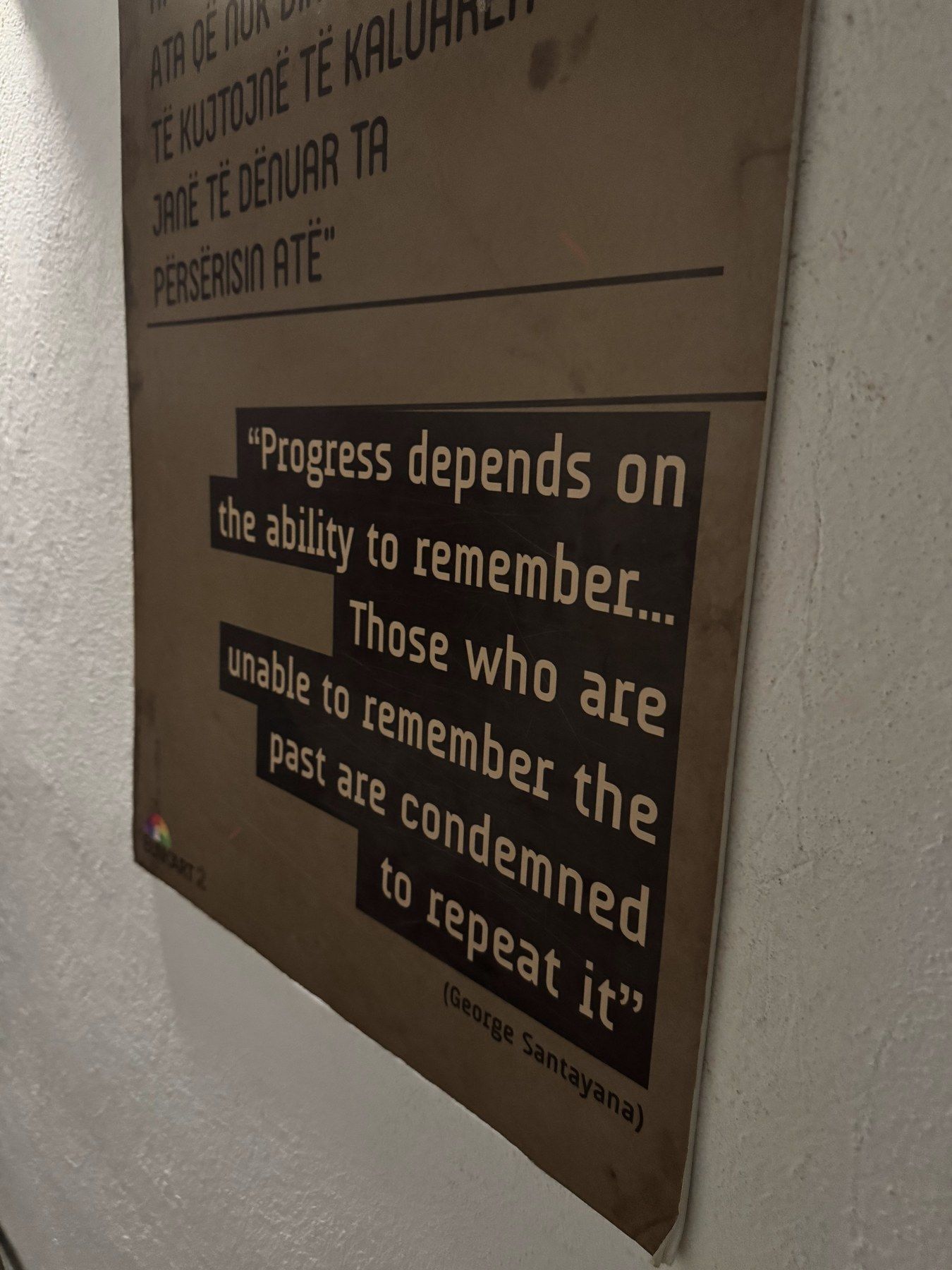
The galleries document the Sigurimi's apparatus of control: espionage, interrogations, political prisons. There are real archives, photographs of detainees, testimonies. And on one of the walls, a phrase that sums everything up: "Progress depends on the ability to remember... Those who are unable to remember the past are condemned to repeat it" (George Santayana). It's in Albanian and English. And it makes complete sense that it's there, in that place.
Keeping that phrase says something about why this museum exists: it's not a monument to defeat, but a decision not to forget.
Religion in Albania: The World's First Atheist State
In 1967, Hoxha declared Albania the world's first officially atheist state. He demolished mosques and churches and banned all religious practice. Paradoxically, he himself came from a Muslim family. The churches you see in Tirana are all modern, rebuilt after 1991. The old ones were destroyed or repurposed into other buildings.
Tirana Today: The City That Stood Back Up
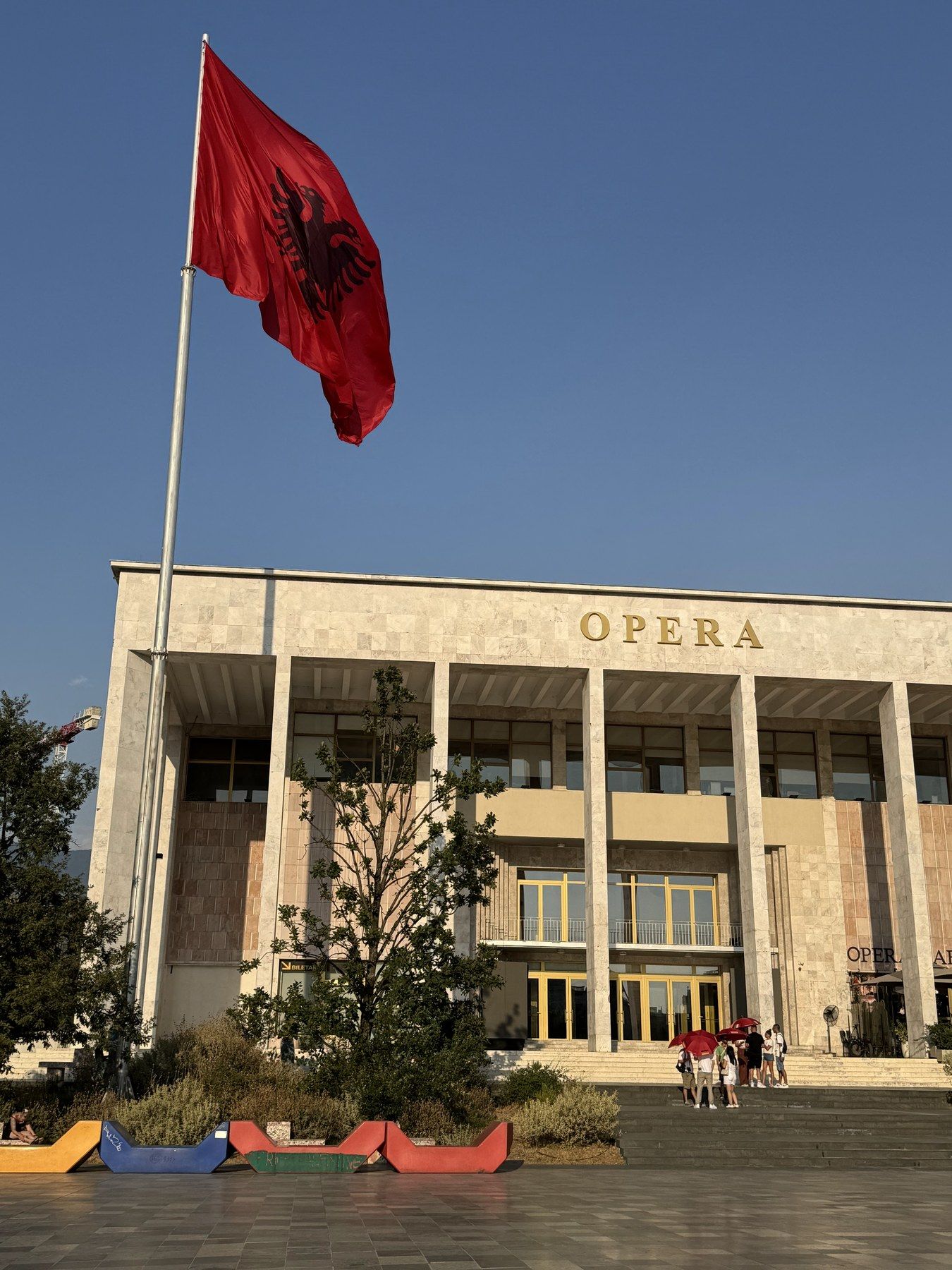
What surprises me most about Tirana is the contrast. A city that lived through 50 years of one of the world's most extreme communist regimes, and today, just 30 years later, looks completely modern: designer buildings, green spaces, renovated plazas, genuine safety on the streets, and young people eager to grow.
I walked through the center all week with my laptop, sat at street-side cafes and never had the slightest feeling of insecurity. That's also what a well-functioning society and government can give you.
The resilience of this people resonates deeply. They didn't just grow after communism's fall; they chose to tell the world what they lived through. That takes courage. And doing it from openness rather than resentment says something profound about their character.
If you're thinking about visiting the Balkans, Tirana shouldn't be missed. Not just for the beaches or the food, but to understand a history that's right there in front of you, visible in every street and building. And to see how a people can rise from the worst.
If you're traveling through northern Albania, the natural next stop is the capital: Shkodër, Albania: What to See, the Bunkers and First Contrasts →
Frequently asked Questions About Tirana and Communism in Albania
How long did communism last in Albania?
Albania's communist regime lasted from 1944 to 1991, when it fell after a student movement toppled Enver Hoxha's statue in Tirana's central square. That's 47 years of communist rule. The most intense period was under Hoxha directly, from 1946 until his death in 1985.
Who was Enver Hoxha?
Enver Hoxha was the communist leader who governed Albania from 1944 until his death in 1985. He was one of Europe's most radical dictators: he eliminated all political opposition, banned religion, completely isolated the country from the outside world, and built 170,000 bunkers for a supposed external enemy that never arrived.
What is the House of Leaves in Tirana?
The House of Leaves is a museum in central Tirana that during communism served as the headquarters of the Sigurimi, Albania's secret police. Phone wiretaps, recordings, mail interception, and surveillance of citizens deemed suspicious by the regime were coordinated from here. Today it's open to the public, preserving the original equipment and archives exactly as they were.
Why are there so many bunkers in Albania?
Albania has around 170,000 bunkers built during Enver Hoxha's regime. He built them to protect the population from a supposed external attack, an enemy he invented to justify total social control. They were never used and today you can see them throughout the country, including in central Tirana.
Is Tirana worth visiting?
Yes, Tirana is absolutely worth visiting, especially if you're interested in history. The city combines a deeply impactful recent history with a surprising modern transformation. The House of Leaves, the Blloku neighborhood, Hoxha's Pyramid, and the bunkers are essential stops for understanding what happened here.