"How long does it take to charge a Tesla?" is probably the most repeated question about these cars. The correct answer is depends on the charger, the model, the temperature and how much battery you start with. The useful answer is this table: with real data measured by me and other owners, not by Tesla's marketing page.
After months planning my Tesla trip across Europe, this is the summary of real charging times for the four main models on each type of charger.
Summary: typical times for a 10–80% charge
The 10 to 80% range is the most useful for planning because it's where charging is fastest and where most owners operate on the road. After 80% the curve slows significantly.
Supercharger V4 (350 kW peak): 18 to 22 minutes for Model 3 LR. 20 to 25 for Model Y. 22 to 28 for Model S and X.
Supercharger V3 (250 kW peak): 20 to 28 minutes for Model 3 LR. 25 to 32 for Model Y. 28 to 35 for Model S and X.
Public CCS fast charger (100–150 kW): 35 to 50 minutes.
Home wallbox 11 kW: 5 to 6 hours.
Home wallbox 7 kW: 8 to 9 hours.
Standard outlet 220V (3.7 kW): 16 to 20 hours.
Times by Tesla model on V4 Supercharger
Model 3 Standard Range
60 kWh battery. Charges 10 to 80% in 15 to 18 minutes under ideal conditions (V4, preconditioned battery, ambient temp 15–25 ºC). Fastest to charge per kWh in the entire Tesla lineup.
Model 3 Long Range
78 kWh battery. 10–80% in 18 to 22 minutes on V4. The sweet spot between range and charging speed.
Model Y Long Range
81 kWh battery. 10–80% in 20 to 25 minutes on V4. Just slightly slower than Model 3 LR because it's heavier and less aerodynamically efficient.
Model S Plaid / Long Range
100 kWh battery. 10–80% in 22 to 28 minutes on V4. Bigger battery but similar charging curve to Model 3.
Model X
100 kWh battery, same pack as Model S. 25 to 30 minutes on V4. Slowest of the lineup because the car is heavier and demands more total energy.
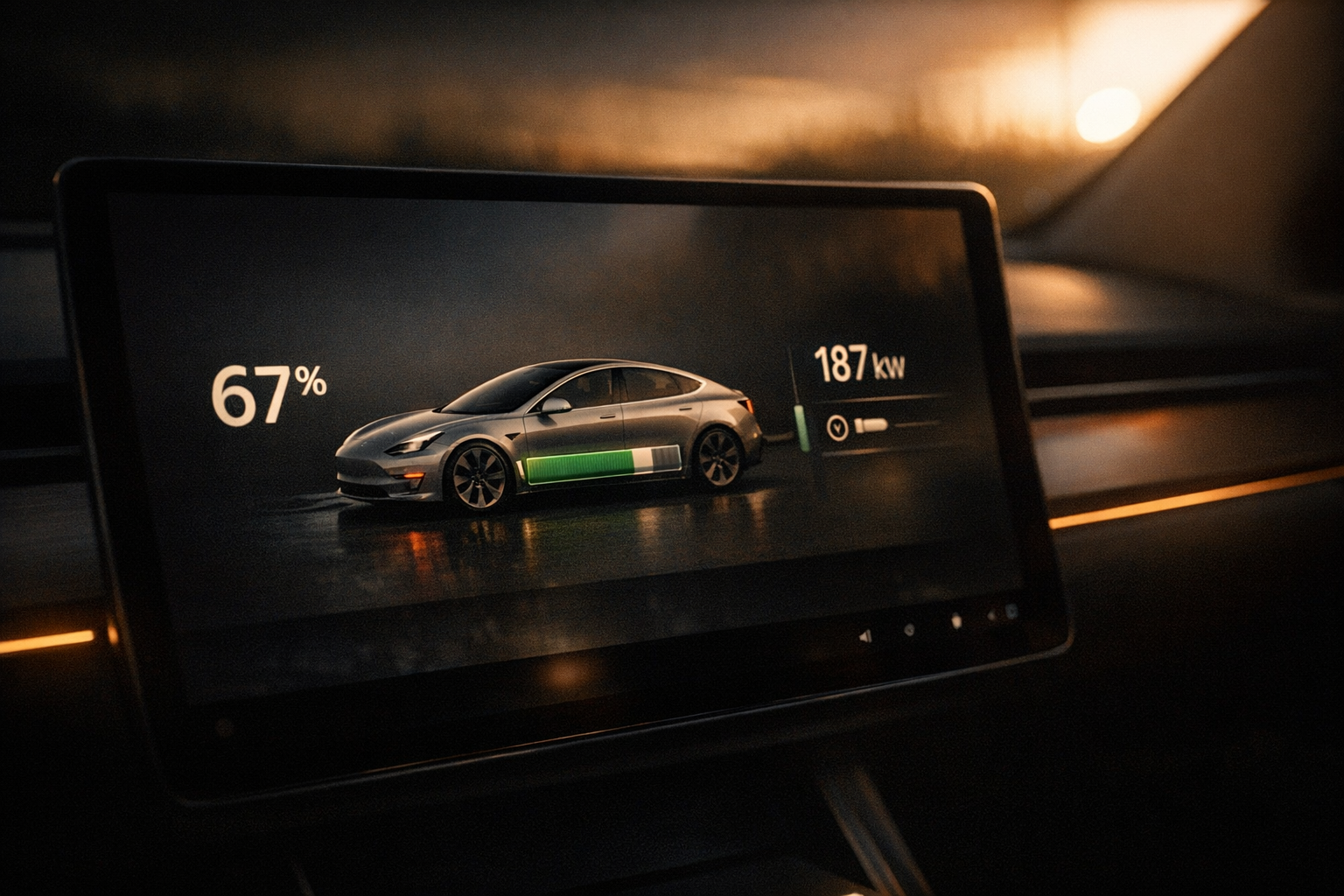
The factors that most affect time
1. Battery temperature on arrival
The factor most people underestimate. A Tesla battery at 25 ºC charges at max speed. The same battery at 5 ºC charges at 40–60% of that speed. The difference can be 10–15 extra minutes on a 25-minute stop.
Solution: use Tesla's Trip Planner. If you select a Supercharger as destination, the car preconditions the battery automatically en route. Huge difference in winter.
2. Starting state of charge
Charging power curve isn't linear. A Model 3 LR goes from 0 to 50% in roughly 12 minutes on a V4. But 50 to 80% takes another 10 minutes. And 80 to 100% takes another 25–30 minutes.
That's why charging from 10 to 80% is always recommended on road trips. Charging to 100% is only necessary if the next charger is very far.
3. Supercharger generation
V2 (150 kW), V3 (250 kW), V4 (350 kW theoretical, 250 kW real via software). Charging on V2 vs V4 can be double the time. Choose V4 if available.
4. How many cars are charging
V2 Superchargers share power between adjacent stalls. If you arrive at one with 8 stalls and 7 are in use, you'll get much less power. V3 and V4 each have their own converter, so this is much less of an issue — but can still happen at peak hours.
5. Battery health
A battery with many years or many cycles can accept less power than a new one. A 2-year-old Tesla typically charges at 100% power. A 6-year-old one may charge at 80%. Normal, not a defect.
Home charging: why taking 8 hours isn't a problem
Home charging seems much slower than Supercharger, but it's that way by design. The premise is that you charge overnight while sleeping. If you arrive home at 10pm with 30% and your car is at 100% by 6am, the 8 hours it took don't matter: you weren't using the car.
Costs: €4 to €7 for a full overnight charge on a night tariff. Compared to €14–20 at a Supercharger, the savings are brutal across a year.
Recommendation: install a 7 to 11 kW wallbox at home if you'll have a Tesla for more than a year. Costs €800 to €1,500 installed, but you recover it in 1–2 years through Supercharger savings.
Charging on a regular outlet: last resort
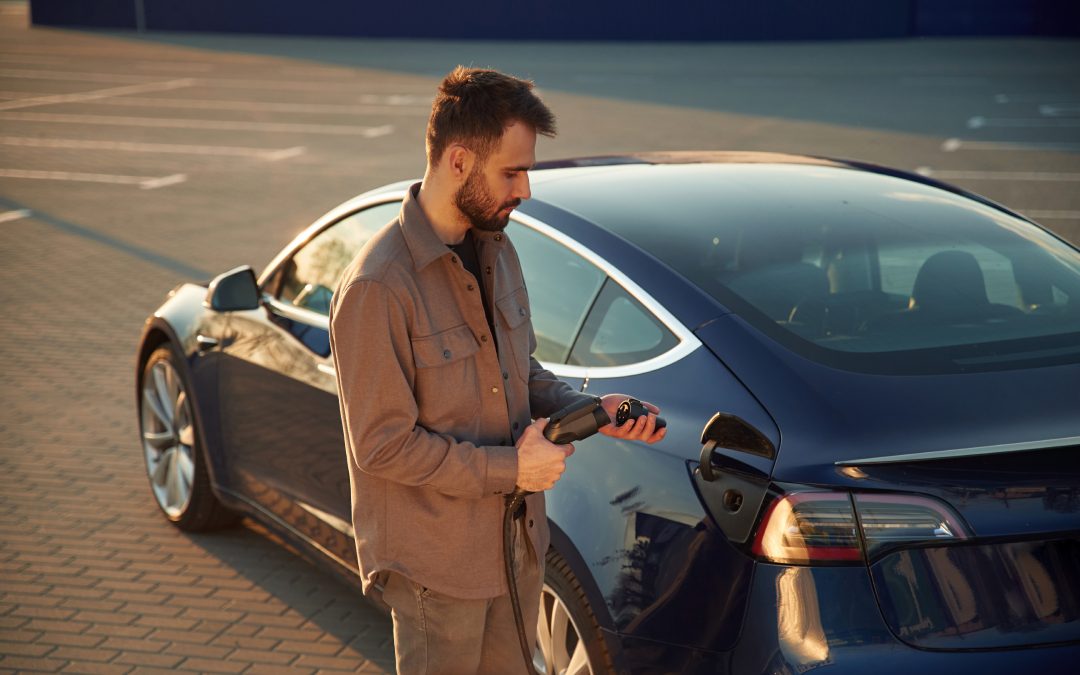
The cable included with the Tesla can plug into a standard household outlet (Schuko 220V 16A). Problem is it charges at only 2.3 kW real (not the theoretical 3.7 due to thermal safety), giving you 30–50 km range per hour.
If you leave it plugged overnight, you recover 250–400 km. Enough to get home if you ran short, but not for daily use.
When to use Schuko: visiting family, at a rural hotel without wallbox, at a countryside house. As a complement, not a primary solution.
Conclusion
Tesla charging times are faster than most think when you use the right chargers. On a V4 Supercharger a useful charge takes the time of a coffee. At home, 8 hours doesn't matter because you charge while sleeping. The only case where it "really takes long" is on standard 220V, which is an emergency solution, not normal use.
To see what each charge will actually cost, read how much it costs to charge a Tesla in Spain. And to understand what Supercharger network is available, see the detailed map at Tesla Superchargers in Spain.