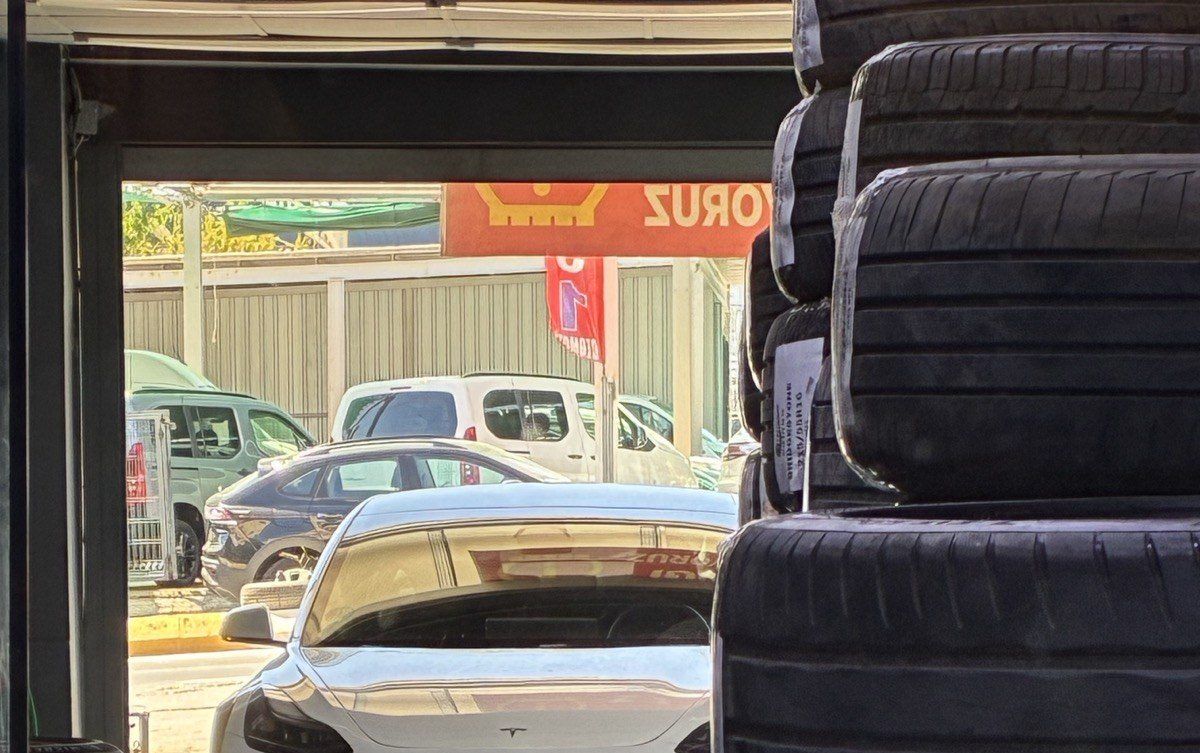
We didn't stop in Istanbul because something broke. We stopped because we knew what was coming.
The Michelin Primacy 4 tyres that left Barcelona with the Tesla still had tread. They weren't destroyed. But after Turkey comes Georgia, after Georgia comes Central Asia, and after Central Asia comes China in November. And that's a completely different world.
The question wasn't whether to change the tyres. It was when. And the answer was: before we no longer had a choice.
The impossible tyre problem on a round-the-world trip
A world road trip in a Tesla doesn't have one climate. It has all of them.
After Turkey, the EchoRoute route goes through Georgia, crosses Central Asia and enters China in November 2026. November in China can mean sub-zero temperatures, snow, and icy mountain roads. But after China we continue to Laos, Thailand and Southeast Asia, where we're back to tropical heat and constant rain.
With summer tyres, a Chinese winter was a real problem. With winter tyres, the blazing asphalt of Southeast Asia would eat through the rubber in weeks.
What we needed was something capable of handling everything: heat, rain, motorway, rough roads, sub-zero temperatures and moderate snow. And on top of that, surviving the thousands of kilometres ahead for a heavy electric vehicle with a lowered suspension and instant torque on every pull.
Why we chose the Michelin CrossClimate 3
The Michelin CrossClimate 3 are all-season tyres with 3PMSF (Three Peak Mountain Snowflake) certification. That certification isn't decorative: it means they're officially rated for real winter conditions, not just rain or mild cold.
The size we needed: 235/45 R18 98Y XL. Exactly what a Tesla Model 3 with 18-inch wheels requires.
The EU label confirms the specs:
- Fuel efficiency: C
- Wet grip: B
- External noise: 72 dB (class B)
- 3PMSF certified
They're not the best summer tyres you can get. They're not the best winter tyres either. They're the best option for someone who needs to go from China in November to Thailand in March without stopping to swap them again.
The alternatives we considered
We didn't arrive at the CrossClimate 3 immediately. We compared three options:
Continental AllSeasonContact 2. Very well balanced, particularly in wet conditions, cold weather and fuel efficiency. They'd be excellent for mixed European driving. For our route, we felt slightly less confident about the winter performance compared to Michelin.
Bridgestone Turanza All Season 6. Very strong in dry and wet. But for what's coming in Central Asia and China, Michelin and Continental gave us more confidence in winter conditions.
In the end, CrossClimate 3. Michelin's reputation in certified all-season winter performance, the balance across different conditions, and the availability of our exact size in Istanbul sealed the decision.
Finding a trustworthy workshop in Istanbul
Finding a workshop that actually knows how to work on a Tesla isn't trivial anywhere in the world. Electric vehicles have specific chassis requirements: they need the right lift pads to raise them without damaging the battery. Not every workshop has them.
We researched before going. LastikMan Otomotiv in Pendik, on the Asian side of Istanbul, had around 4.9 out of 5 with almost 40 reviews when we contacted them. They sent us photos of other electric vehicles they'd worked on: Tesla, Porsche, Mercedes, BMW, BYD. And they confirmed they had the specific pads for lifting a Tesla safely.
Uğur Didin, who managed the whole process, sent us photos of the tyres before fitting, with the original Michelin labels and the DOT clearly visible: 1326, week 13 of 2026. Tyres manufactured in March 2026. Brand new.
That's not something you can take for granted. The DOT matters.
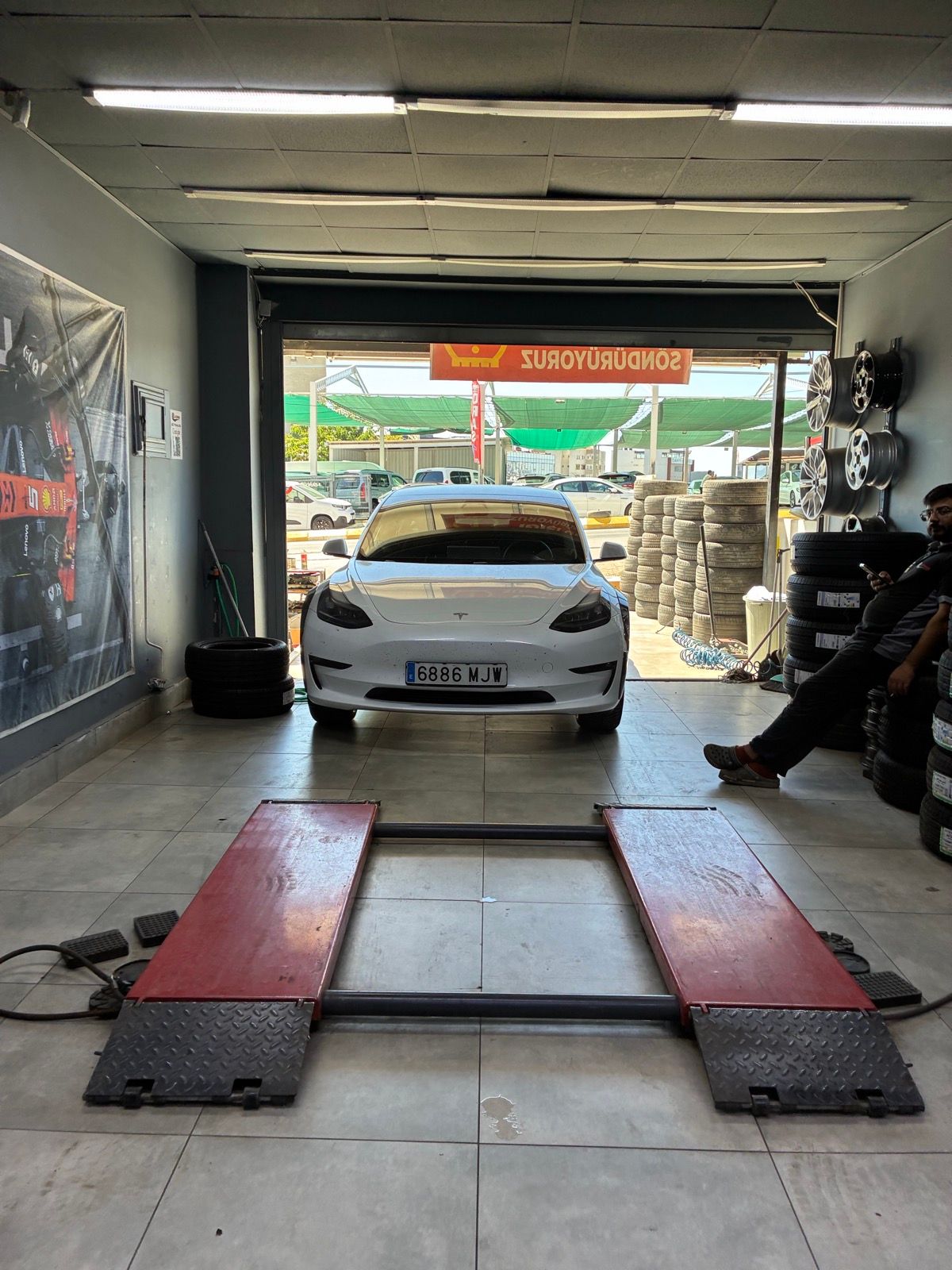
The day of the change: what we expected and what we didn't
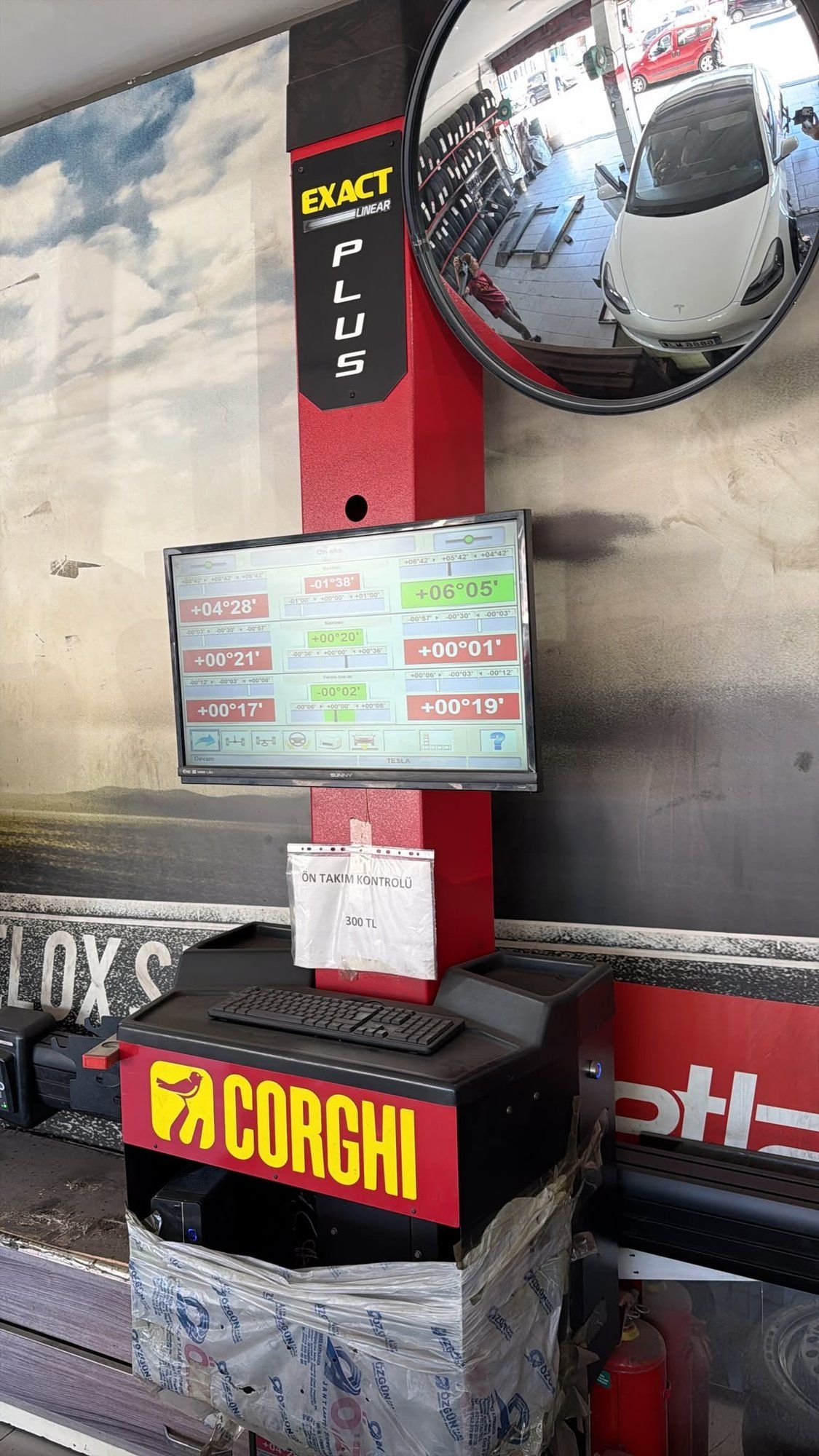
The planned work was tyre fitting, balancing, and wheel alignment. The alignment was especially important because the Tesla's suspension is lowered: with a poorly adjusted geometry, the interior wear on the tyres accelerates significantly.
Uğur explained they would connect the car to the alignment machine and adjust whichever wheels needed it. If all four needed correction, all four would get it.
What we didn't expect was that the rims also needed repair. The unplanned work added 8,000 TL to the original budget. With the tyre fitting, balancing, alignment and rim repair, the final total came to 58,500 TL (around €1,000–1,050 at the exchange rate at the time).
After fitting, the Tesla was showing tyre pressures between 36 and 38 psi. Tesla's recommended pressure is 42 psi. We asked immediately.
Uğur explained he'd left it intentionally lower. Turkish roads aren't always in great condition, and a slightly softer tyre absorbs impacts better and protects the freshly repaired rims. He recommended keeping that pressure around Istanbul and returning to 42 psi with cold tyres before heading to Georgia.
That makes sense. And it says something good about the workshop: they didn't just fit and forget.
Condition of the tyres leaving the workshop
We checked all four wheels before leaving. Deep tread, perfectly defined edges, manufacturing marks still visible. The small rubber flashes left by the moulds are a sign no one has used them before. The V-shaped CrossClimate tread pattern, clean and symmetrical.
The old Michelin Primacy 4 stayed at the workshop. There's no point travelling with four used tyres inside the car for months.
How long they'll last and how we'll look after them
Under normal use, CrossClimate 3 tyres can last 60,000–80,000 km. For our type of driving, we estimate 40,000–50,000 useful kilometres. EchoRoute conditions are demanding: heavy vehicle, instant torque, car loaded with luggage, roads of very variable quality, lowered suspension, and extreme temperature swings.
Our maintenance plan:
- Check pressure regularly, always with cold tyres
- Watch interior wear due to the lowered suspension
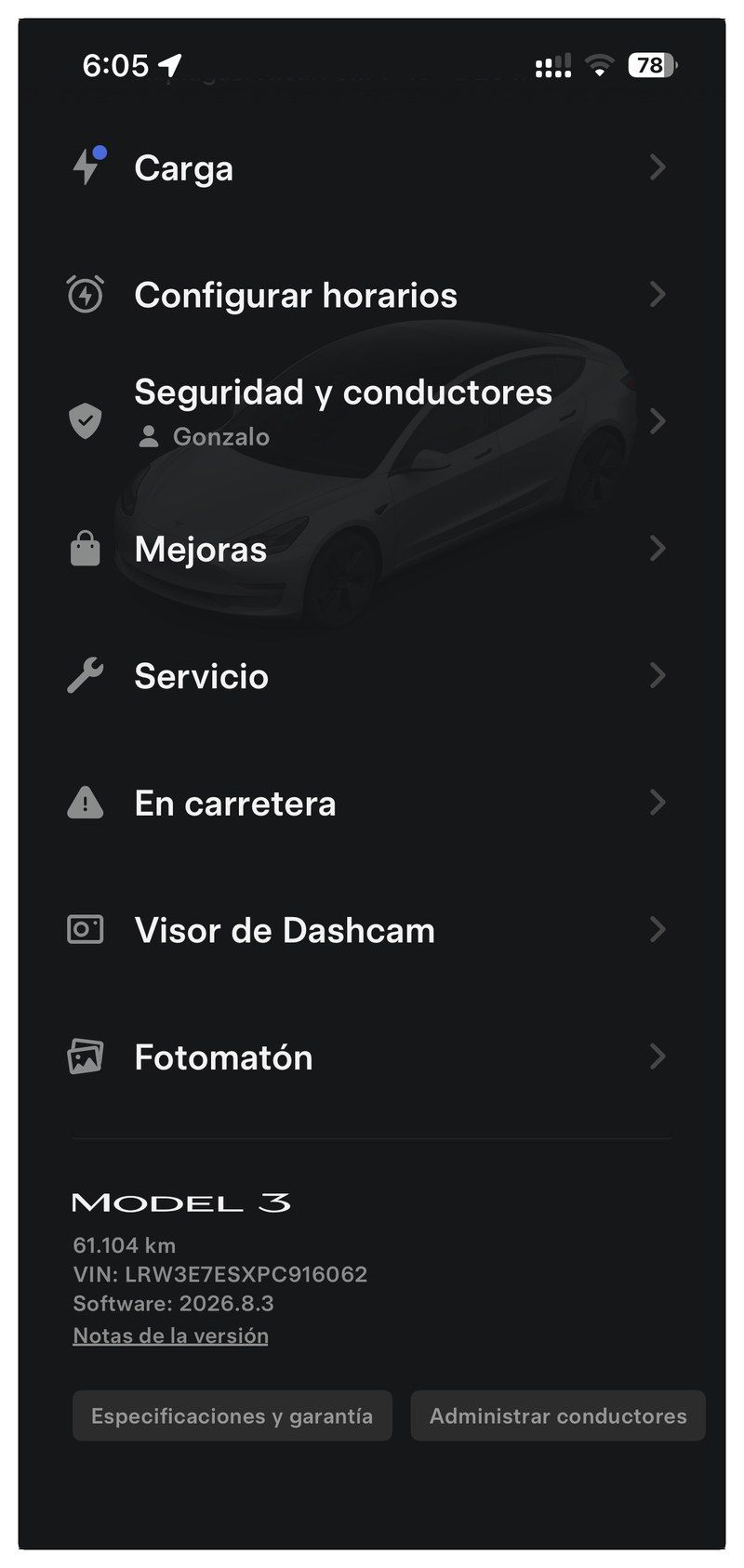
- Rotate approximately every 8,000–10,000 km (next check: ~69,000 km)
- Check geometry if the car behaviour changes
Istanbul as a strategic stop, not a break
This tyre change isn't a side story. It's part of the logic of the journey.
Driving around the world isn't just about crossing borders and discovering places. It also means preparing the vehicle with thousands of kilometres ahead in mind, finding trustworthy workshops in unfamiliar countries, and making preventive decisions before they become emergencies.
Istanbul was the moment. After the Balkans, before Asia. With time to research properly, choose well, and get the work done without rushing.
The CrossClimate 3 tyres that left LastikMan's workshop in Pendik are going to cross Georgia, Central Asia, China and Southeast Asia. If they do half of what they promise, every Turkish lira will have been worth it.
A huge thanks to Uğur and the entire LastikMan team for the communication, the photos, the attention to detail, and the work itself. This is not a sponsored collaboration: we found them, we chose them, and we paid for the job.
Frequently asked questions about Tesla tyres for long road trips
What are the best all-season tyres for Tesla Model 3?
The standard size for a Tesla Model 3 with 18-inch wheels is 235/45 R18 98Y XL. Good all-season options in this size include the Michelin CrossClimate 3, Continental AllSeasonContact 2, and Bridgestone Turanza All Season 6. The key is making sure they're XL (Extra Load) rated to handle the weight of an electric vehicle.
Are all-season tyres good enough for snow on a Tesla?
It depends on the certification. Generic all-season tyres are not rated for snow. Tyres with the 3PMSF certification — like the CrossClimate 3 — are officially rated for real winter conditions. For occasional snow on a road trip, 3PMSF all-season tyres are sufficient. For dense snow or constant ice, dedicated winter tyres remain the safest option.
How long do Tesla tyres last?
Generally less than on combustion vehicles. Instant torque and battery weight accelerate wear. Under typical conditions, expect 25,000–50,000 km depending on driving style, model and tyre type. Rotating every 8,000–10,000 km extends tyre life significantly.
Do you need a specialist workshop to change tyres on a Tesla?
Not strictly necessary, but highly recommended. The critical point is the lift pads: if a workshop raises the car at the wrong point, it can damage the battery or chassis. A workshop with experience in electric vehicles, or one that confirms they have the right Tesla lift blocks, is the safest choice.
What tyre pressure does Tesla Model 3 need?
Tesla recommends 42 psi (2.9 bar) front and rear for the Model 3 with 18-inch wheels. Always check with cold tyres, before driving. Incorrect pressure affects consumption, range and wear.
Can you get Tesla tyres changed anywhere in the world?
Technically yes, but it requires research in advance. In most major cities around the world there are workshops with electric vehicle experience. The most important things to confirm are the exact tyre size (235/45 R18 in our case), availability of the brands you want, and that the workshop has the correct lift equipment for a Tesla.
What tyres does Tesla Model 3 come with from the factory?
It depends on the year and market. European versions have shipped with Michelin Primacy 4, Continental SportContact 6, or Goodyear Eagle F1 depending on production quarter. There's no single factory brand — Tesla negotiates with different suppliers. What stays constant is the size (235/45 R18 on the standard model) and the XL load rating requirement.
How much does it cost to replace all four Tesla tyres in Europe?
Between €600 and €1,200 depending on brand, retailer and whether fitting, balancing and alignment are included. CrossClimate 3 in 235/45 R18 run around €130–160 each in Spain. Add labour (€50–100) and wheel alignment if needed (€80–150 extra). A complete four-tyre swap with everything typically comes to €700–900 at a specialist workshop.
Can a Tesla get a flat tyre, and what do you do?
Yes. Most Tesla models don't include a spare wheel: they come with a temporary repair kit (inflator and sealant) for small punctures. If the damage is to the sidewall or too large, the sealant won't work and you'll need roadside assistance. On long road trips, some owners carry a spare in the frunk or take out a tyre insurance policy. We carry a repair kit and international breakdown cover.