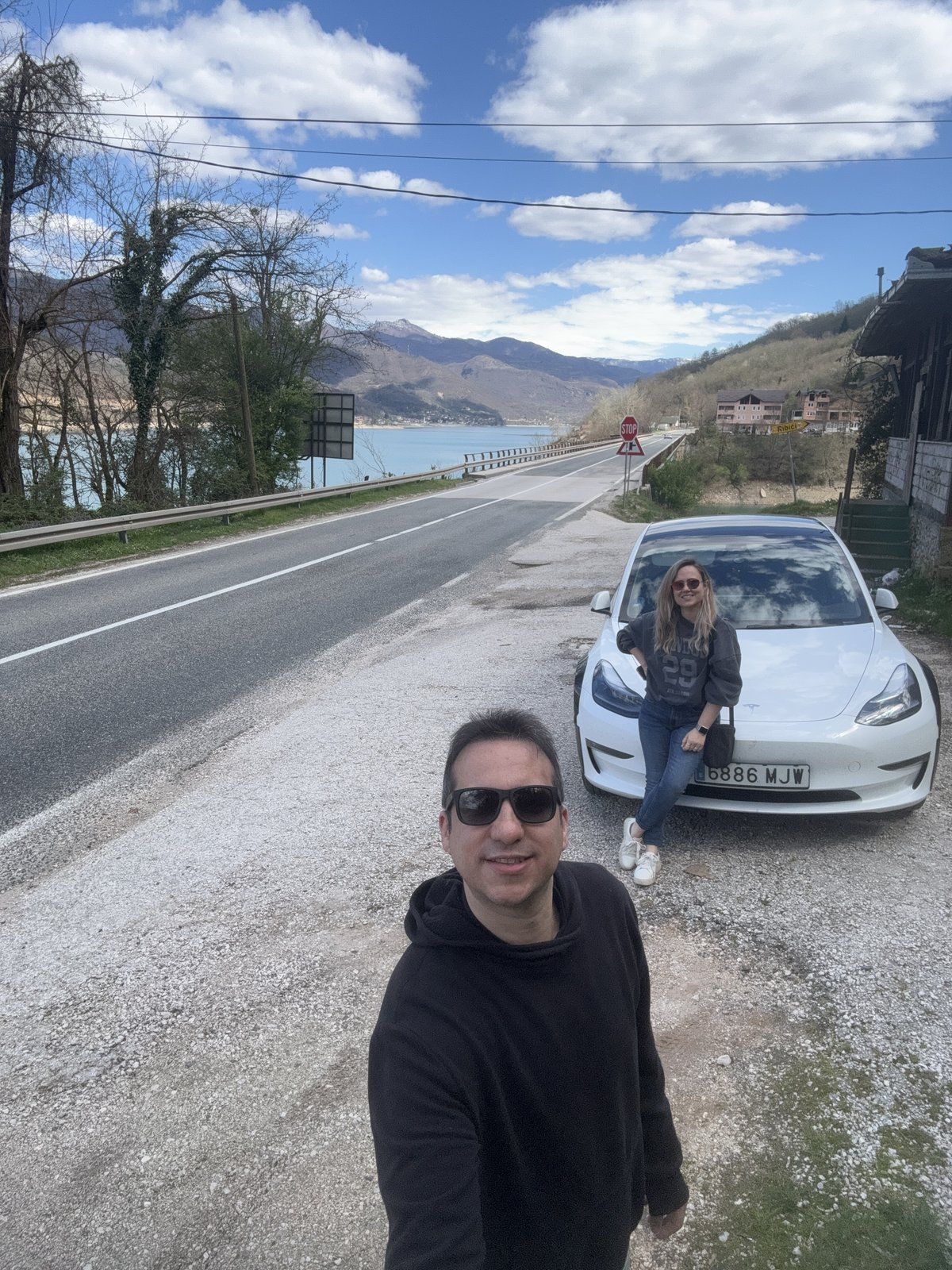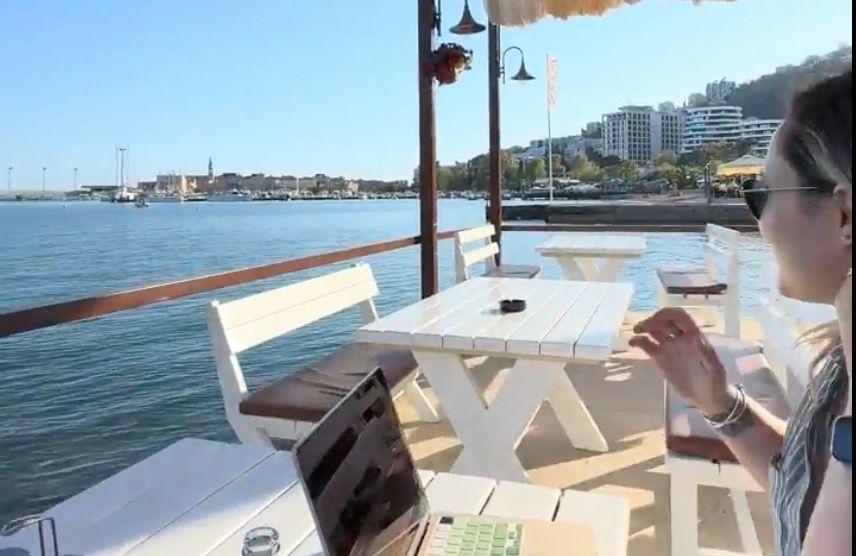
When we started thinking about crossing China in a Tesla, we imagined the car would be the biggest challenge.
The permits to drive a foreign vehicle, the temporary license plates, the authorized route, the chargers, the mileage. All of that is still complex, but we found solutions. Now there's another question that could change the entire trip: can we work normally while we're there?
For us, it's not a minor detail. We live off remote work while we travel the world, so we're not doing this trip during a vacation or able to disconnect for several weeks until we reach the next country.
During the week, we work. The trip moves forward on weekends, because when Monday arrives, we need to be available to our clients, access our tools, and have adequate conditions to join meetings.
In China, nobody can guarantee us that's going to work normally.
The problem isn't having internet in China
China has internet — just not the same internet we use to work.
Years ago, the Chinese government decided to cut off foreign platforms and let its own grow instead: Baidu instead of Google, WeChat instead of WhatsApp, Weibo instead of Twitter. That blocking system is called the Great Firewall.
Services like Google, Instagram, YouTube, or LinkedIn aren't normally available from a local connection. For a tourist, not being able to open Instagram for a few days might be an inconvenience. For us, losing access to Google Drive, LinkedIn, AI tools, or video calls means we can't work the way we normally do.
To access these platforms, many travelers look for a VPN that works in China — essentially a tunnel that makes your connection appear to originate from another country, even if you're physically in China. The problem is that the Great Firewall also tries to detect and block those connections, and how well it works can change depending on the moment, the network, or the region.
That explains why the reviews are so contradictory: the VPN that works perfectly for one person might fail for another, or not have enough speed to sustain a meeting.
The problem isn't being without internet. It's having a connection and still not being able to work.
We watched a lot of videos and ended up with fewer answers
We started the way almost every travel research begins: looking for other people's experiences.
We watched YouTube channels from travelers who had been through China, videos about eSIMs, international connections, and VPN comparisons. Some said they'd worked without problems — maybe a slight connection delay. Others explained which combination had worked for them.
Then we'd open the comments.
Under a video where everything seemed solved, people would appear saying that same VPN hadn't connected even once. In another, someone described using all their apps with an international eSIM, while someone else said the connection was too slow to work.
What worked for one person didn't work for another. And everyone seemed equally convinced they had the answer — even though there's no single magic solution that guarantees we won't have problems.
The network, the city, the accommodation, the provider, the device, and even the timing of the trip can all change the outcome. The Great Firewall isn't a static structure, either. Research shows that its mechanisms evolve and that the system also tries to identify encrypted connections used to bypass the blocks.
So after many hours of videos, forums, and comments, our conclusion wasn't: "This is the VPN we need."
It was considerably less reassuring: there's no solution we can count on before we even enter.
A VPN is not a business continuity plan for remote work in China
We could install several VPNs, get more than one eSIM, and arrive with different options ready.
We'll probably do that if we end up crossing China. But having alternatives isn't the same as having guarantees.
A VPN might let us open services that wouldn't normally be available, but it can also reduce speed, disconnect, or stop responding. And there's an important difference between managing to send a message and sustaining a full workday.
We need to join video calls, access our clients' platforms, use AI tools, share documents, send files, and respond across different channels.
Here's another problem: not everything depends on China's firewall. Providers themselves set restrictions on which countries and regions they allow to use their services.
OpenAI does not include mainland China among the countries and territories permitted to use its API. The company warns that accessing or providing access from an unsupported region may result in account blocking or suspension.
Anthropic also doesn't include mainland China among the regions where it offers commercial access to its API or to Claude. Its documentation states that accounts may only be created and used from supported locations.
This changes the question considerably. It's no longer just about finding a VPN that opens a platform — it's about whether we can use tools that are central to our work without violating provider terms or putting our accounts at risk.
Even services that are available may work differently. Microsoft explains that connections made from hotels, cafés, or residences in China to its global services may experience congestion, latency, and packet loss when crossing China's international circuits.
These are problems that particularly affect video calls and file transfers.
Companies with operations in China may have private networks, technical teams, and infrastructure specifically designed to work there. We would arrive as two people, two laptops, and a Tesla.
That's not exactly the same setup.
The restrictions aren't only China's — though they vary depending on how you work
This isn't exclusive to AI tools or to us. Remote work doesn't mean being able to work from anywhere, and the restrictions change depending on how you work.
If you own your business, freelance, or work with your own clients, restrictions usually come from contracts: some require operating from specific countries for legal, tax, or data security reasons, which can limit where you can invoice or provide services without issues.
If you're employed by a company, restrictions come from the employer. Many companies simply don't allow connections from certain locations due to security or compliance policies, regardless of whether the person has approved remote work.
In every case, restrictions exist. What changes is who sets them — not whether they're there.
Our clients don't care that we're in China
We can research for months, install several apps, and save instructions for every possible scenario.
But if a meeting drops, the person on the other end won't find much comfort in knowing we watched a lot of YouTube videos before we arrived.
We also can't explain that the Great Firewall decided to block our VPN that morning. That might be a true explanation, but it still doesn't solve the problem.
As digital nomads, our way of traveling rests on one fairly simple rule: movement should not transfer uncertainty to the people who work with us.
That's why we change cities on weekends, arrive with time to settle in, and check the connection before starting a new week. If an accommodation doesn't have a proper workspace, we find a coworking space. If the wifi fails, we use mobile data.
Until now, we've always been able to build an alternative.
China changes that logic because several of the possible solutions depend on the same uncertain point: the ability to connect stably to the global internet.
Having a Plan B isn't enough if Plan B can fail for the same reason as Plan A.
Crossing China wouldn't be a two-day test
If we flew to a Chinese city for a weekend, we could check what works and come back.
Crossing the country in our own Tesla is something else entirely.
It requires a route, permits, coordination, and a commitment of time that doesn't allow us to go in on a Saturday, test the connection, and leave on Sunday if something goes wrong.
Once inside, we'd need to find bases from which we could work during the week and continue the route on weekends. That system only works if we can open our laptops on Monday and work normally.
We can't cross a country that size trusting that some VPN will eventually work. We also don't want to discover from a hotel room that the tool we were counting on as a backup stopped connecting at the same time as the first one.
Right now, we still can't answer yes.
The biggest risk is the one we can't control
With the Tesla, we can calculate range, find chargers, and adapt the route. There may be unexpected situations, but at least we know the main variables.
With connectivity, it's different. We can subscribe to services, prepare alternatives, and run tests before entering — but the real test only happens once we're already inside China.
Even then, something working on the first day doesn't guarantee it will keep working over the following weeks.
That's the part we find hard to accept. We're used to solving problems along the way, but working with clients can't permanently depend on our ability to improvise.
There's a difference between switching cafés because the wifi is slow and not knowing whether we'll be able to access the tools we use every day.
We don't need a perfect connection. We need one that's predictable enough for the trip to remain our choice.
China is still on the map — but now it has a question mark
We want to cross China. Not just drive through it to reach the other side, but to travel it, understand it, and document what it's like to take a trip in an electric vehicle through a country so different from all the ones we've visited so far.
But wanting to do it doesn't resolve the most important part. Before entering, we'll need to know which tools we can use, which connection options are viable, and what level of stability we can realistically expect. We'll also need to decide what risk we're willing to accept and what would be the point at which we'd change the route.
Maybe we'll find a combination that works. Maybe we can organize the crossing differently. There's also the possibility that China simply isn't compatible with the way we sustain this trip today.
We don't know yet.
For now, the route is still open on the map. The Tesla can cross it. So can we.
What we don't know is what will happen on Monday morning, when we park, open two laptops, and try to start working.